The Indus valley civilization, a bronze age civilization, like the other three civilizations of the ancient world which developed along the river banks (Egyptian on Nile, Mesopotamian on Tigris–Euphrates, Chinese on the Yangtze), had developed on banks of Indus and several other nearby rivers such as Ghaggar– Hakra, the now dried up Saraswati and the Drasadvati. The centre of this civilization was in Sind and Punjab and from there, it spread in all directions. This civilization was largest of the four ancient urban civilizations of Egypt, Mesopotamia, South Asia and China.

Features of Indus Valley Civilization
- BC. 2700- BC.1900 ie for 800 years.
- On the valleys of river Indus, Also known as Harappan Civilization.
- Beginning of city life.
- The city was divided into Citadel(west) and Lower Town(east).
- Red pottery painted with designs in black.
- Stone weights, seals, special beads, copper tools, long stone blades etc.
- Copper, bronze, silver, gold present.
- Artificially produced – Faience.
- Specialists for handicrafts.
- Import of raw materials.
- Plough was used.
- Bodies were buried in wooden coffins, but during the later stages ‘H symmetry culture’ evolved where bodies were buried in painted burial urns.
- Sugar cane not cultivated, horse, iron not used.
MOST IMPORTANT SITES OF INDUS CIVILISATION
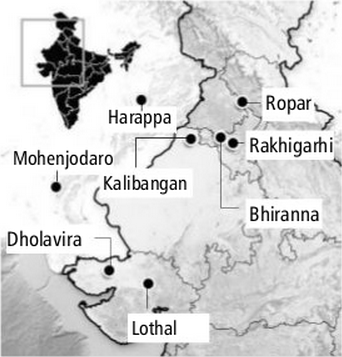
HARAPPA, Harappa is the first discovered site of this civilization excavated in 1921 by a team led by Daya Ram Sahni. It was a major urban centre during its mature phase surrounded by extensive walls. It is located in Punjab Province, Pakistan, on an old bank / bed of the River Ravi. Its location along old course of Ravi provided access to trade networks, aquatic food and water for drinking and cultivation.
- Seals out of stones
- Citadel outside on banks of river Ravi
MOHEN-JO DARO, Mohenjo-Daro (mound of dead) was excavated by a team led by R.D. Banerjee in 1922. It is located in the Larkana District of Sindh Pakistan on bank of Indus River.
- Great Bath, Great Granary, Dancing Girl, Man with Beard, Cotton, Assembly hall
- The term means ” Mount of the dead”
- On the bank of river Indus
- Believed to have been destructed by flood or invasion(Destruction was not gradual).
CHANHUDARO
- Bank of Indus river. – discovered by Gopal Majumdar and Mackey (1931)
- Pre-Harappan culture – Jhangar Culture and Jhukar Culture
- Only cite without citadel.
KALIBANGAN
Kalibangan is in Hanumangarh district of Rajasthan. It was located on the banks of now dried up Sarwaswati River, kalibangan literally means ‘black bangles’.
- Fire Altars
- Bones of camel
- Evidence of furrows
- Horse remains ( even though Indus valley people didn’t use horses).
- Known as third capital of the Indus Empire.
LOTHAL, Lothal is located in Ahmadabad, Gujarat. It was a coastal town and had different type of town planning. The city was divided into six sections and each section was built on a wide platform of unripe bricks. Entry to the houses were on Main Street while other sites of IVC have lateral entry. Important Findings of Lothal an artificial dockyard {which makes it an important sea link}, rice husk {rice husk has been found only at Lothal and Rangpur}, bead making factory etc. Lothal is thought to have direct sea trade links with Mesopotamia because of finding of an Iranian seal from there.
- Storehouse
- Dockyard and earliest port
- double burial
- Rice husk
- House had front entrance (exception).
DHOLOVIRA, Dholavira is located in Rann of Katch of Gujarat. It is excavated in 1990s by a team led by R S Bisht. It had several large reservoirs, an elaborate system of drains to collect water from the city walls and house tops to fill these water tanks. Harappa, Mohenjo-Daro and Dholavira are called the nucleus cities of the civilization. Unlike the Harappa and Mohenjo-Daro where there are two settlements, in Dholavira 3 citadels or principal divisions have been found which have been duly protected by fortifications. There is an open ground out of the fortifications. In Dholavira there has been found the inner enclosure of the citadel too which has not been found in any other cities of the Harappan culture. One of the most important findings of Dholavira has been a signboard with Indus Script.RAKHIGARHIRakhigarhi in Hissar, Haryana is now considered as the largest site of Indus Valley civilisation. The archaeological excavations at Rakhigarhi revealed all the definite features of Indus civilization such as potter’s kiln, an elaborate drainage system, a granary, ritualistic platforms and terracotta figurines.
THE RELIGION OF INDUS VALLEY PEOPLE
- Pashupathi Mahadev (Proto Siva)
- Mother goddess
- Nature/ Animal worship
- Unicorn, Dove, Peepal Tree, Fire
- Amulets
- Idol worship was practised ( not a feature of Aryans)
- Did not construct temples.
- The similarity to Hindu religious practises. (Hinduism in its present form originated later)
- No Caste system.
INDUS VALLEY SOCIETY AND CULTURE
- The systematic method of weights and measures ( 16 and its multiples).
- Pictographic Script, Boustrophedon script – Deciphering efforts by I. Mahadevan
- Equal status to men and women
- Economic Inequality, not an egalitarian society
- Textiles – Spinning and weaving
- 3 types – burial, cremation and post-cremation were there, though burial was common.
- Majority of people Proto-Australoids and Mediterranean (Dravidians), though Mongoloids, Nordics etc were present in the city culture. Read more on races of India.
CHARACTERISTICS OF INDUS VALLEY CIVILISATION- MATURE PHASE TOWN PLANNING
- first urban societies in South Asia
- sophistication in town planning, and urban amenities the people lived in well-planned cities.
- careful planning of the town, fine drainage system, well arranged water supply system
- The main streets and roads were set in a line, Most of these roads and streets were paved with fire brunt bricks.
- big multi–pillared halls have also been discovered at the citadel area in Mohenjo-Daro.
- The Great Granary was another important building. The surplus produced by the peasants was stored here.
THE DRAINAGE SYSTEM, The Drainage System of the Indus Valley Civilization was far advanced. The drains were covered with slabs. Water flowed from houses into the street drains. The street drains had manholes at regular intervals. All soak pits and drains were occasionally cleaned by workmen. In every house there was a well- constructed sink, and water flowed from the sink into the underground sewers in the streets. This elaborates drainage system shows that the Indus Valley people were fully conversant with the principles of health and sanitation.
INDUS CIVILISATION AND MODERN URBANISATION
The Indus Valley Civilization displayed remarkable planning in its urban towns, especially in the area of sanitation and drainage. In the Indus Valley Civilization, the streets were built on grid-like patterns, which allowed for methodical and planned growth. In modern times, Le Corbusier’s plans for Chandigarh provided for a rectangular shape with grid iron pattern, which enabled fast movement of traffic and reduced the area. In the Indus Valley Civilization, the town was also demarcated clearly between residential areas and common/public areas.
Drainage system was designed such a way that all the houses are connected to street drains. These drains lead to an outer drain and provision for loose bricks for cleaning. Also every house was built with bathrooms. Great bath is assumed for some special rituals. A sophisticated and technologically advanced urban culture is evident in the Indus Valley Civilization. The quality of municipal town planning suggests the knowledge of urban planning and efficient municipal governments which placed a high priority on hygiene. The Indus civilization’s economy appears to have depended significantly on trade, which was facilitated by major advances in transport technology. Thus to a great extent, it can provide inputs to the present day urbanisation.
WATER CONSERVATION OF DHOLAVIRA
Water conservation of Dholavira speaks volume of the ingenuity of the people who developed a system based on rainwater harvesting to support life in a parched landscape, with scanty sweet water. Relying partly on rain-water and little from the ground a complex water system comprising of large rock-cut reservoirs, located at the eastern and southern fortification and rock-cut wells were developed. Huge stone drains can be seen in the city the directed storm water to the western and northern section of the lower town separated by broad bunds, creating in-effect a series of reservoirs. The most imposing well was located in the castle and is possibly the earliest example of a rock cut well. The city also drew water from the seasonal streams flowing on the northern and southern faces of the fortification. The water from these streams was slowed by a series of dams and partly channelized water into the lower town. Every drop of water was conserved to ensure survival.
SCIENCE AND TECHNOLOGY
A sophisticated and technologically advanced urban culture is evident in the Indus Valley civilization. An amazing sewage and drainage system, uniform standard of weights and measures, and advanced buildings are evidence of this. The Harappans were among the first to develop a system of uniform weights and measures. The advanced architecture of the Harappans is shown by their impressive dockyards, granaries, warehouses, brick platforms and protective walls. The massive citadels of Indus cities that protected the Harappans from floods and attackers were larger than most Mesopotamian ziggurats. Unique Harappan inventions include an instrument which was used to measure whole sections of the horizon and the tidal dock. In addition, the Harappans evolved new techniques in metallurgy, and produced copper, bronze, lead and tin.The designing of the Lothal dock and warehouse and the provision of manholes and sewers in cities are other examples of the Harappan scientific approach to human problems. The scientific approach of the people of the Indus Valley is indicative of their technologically advanced and efficient lifestyle.
Reasons for Decline of Indus Valley Civilization
Though there are various theories, the exact reason is still unknown. As per a recent study by IIT Kharagpur and Archaeological Survey of India, a weaker monsoon might have been the cause of the decline of Indus Valley Civilization. Environmental changes, coupled with a loss of power of rulers (central administration) of Indus valley to sustain the city life might be the cause (Fariservis Theory). There might be a resource shortage to sustain the population, and then people moved towards south India. Another theory by Dr Gwen Robbins Schug states that inter-personal violence, infectious diseases and climate change had played a major role in the demise of the Indus Valley Civilization.Other theories:
- Aryan Invasion: Motimer Wheeler
- Tectonic Movements/ Flood – Robert Raikes
- Change of course of river Indus – Lambrick.
references
https://www.google.com/url?sa=i&source=images&cd=&ved=2ahUKEwjGoPip19fiAhWOfysKHToVADEQjRx6BAgBEAU&url=https%3A%2F%2Fgurumavin.com%2F5000-year-harappan-stepwell-found-in-kutch-bigger-than-mohenjo-daros%2F&psig=AOvVaw3Tkx3S0BrptWZdZmkPUPm1&ust=1560007556077011https://www.clearias.com/indus-valley-civilization/https://neoias.com/images/pdf/HISTORY/2.%20INDUS%20CIVILISATION.pdf
https://www.google.com/url?sa=i&source=images&cd=&ved=2ahUKEwiWw4za19fiAhWNfCsKHS8DBigQjRx6BAgBEAU&url=https%3A%2F%2Fbyjus.com%2Ffree-ias-prep%2Fimportant-facts-about-indus-valley-civilization-for-upsc-exams%2F&psig=AOvVaw0zS2ZsQ1z_LsqHkSpO4RcQ&ust=1560007696895587
 ArchBuddy